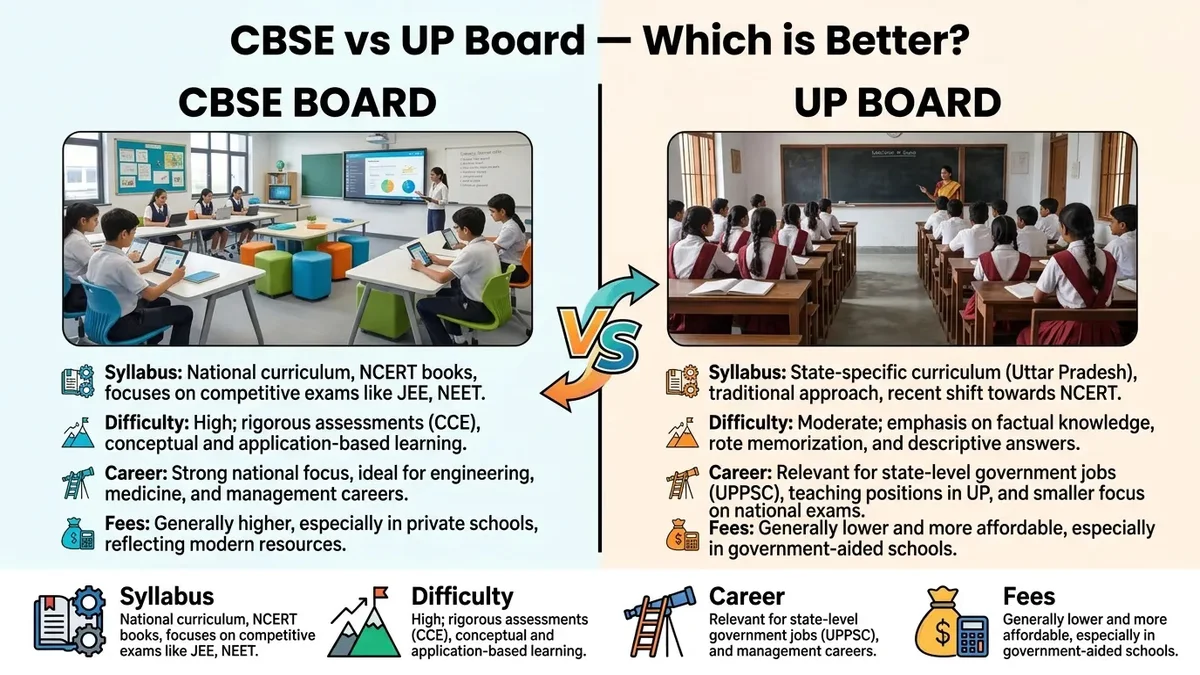
Choosing between CBSE and UP Board is a crucial decision for students in Uttar Pradesh. Both boards have their strengths and weaknesses, especially when it comes to competitive exam preparation. Here is a detailed comparison to help you make the right choice.
CBSE vs UP Board: Key Differences
| Aspect | CBSE | UP Board |
|---|---|---|
| Medium | English/Hindi | Hindi/English |
| Textbooks | NCERT | UP Board textbooks |
| Syllabus | Nationally standardized | State-specific |
| Exam Pattern | Conceptual, application-based | More theoretical, memory-based |
| Competitive Exam Relevance | High (JEE/NEET based on NCERT) | Moderate (needs extra preparation) |
| Difficulty Level | Moderate | Easier (higher pass percentage) |
Impact on Competitive Exams
JEE Main/Advanced: CBSE students have a clear advantage as JEE is based on NCERT syllabus. UP Board students need to study NCERT separately.
NEET: 70-80% of Biology questions come directly from NCERT. CBSE students are naturally better prepared. UP Board students must read NCERT additionally.
CUET: Both boards are equally represented. However, CBSE students tend to score higher due to better conceptual understanding.
Which Board Should You Choose?
Choose CBSE if: Your child is targeting JEE, NEET, or national-level competitive exams. NCERT is the base for all major entrance exams.
Choose UP Board if: Your child is focused on state-level exams, wants higher board marks, or plans to study in UP-based colleges.
Best strategy: Many students study in UP Board schools but read NCERT textbooks additionally for competitive exam preparation.
Board Exam Coaching at JGPS
JGPS School Joya follows CBSE curriculum with focus on competitive exam preparation. Call +91 9412137554 for admissions.
August 2026 Update
CBSE has implemented NEP 2020 changes including two board exams for Class 10 and three-language policy. UP Board is also aligning with NEP. Source: CBSE & UP Board (August 2026).