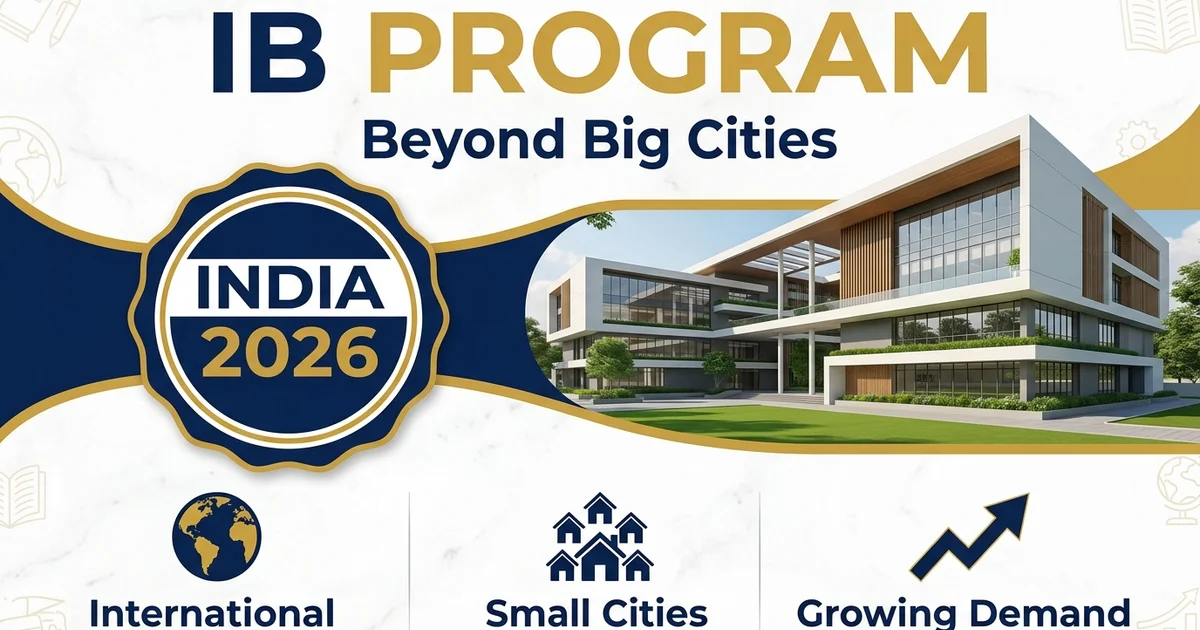
For years, the International Baccalaureate (IB) school program was a metro-only privilege. Delhi, Mumbai, Bangalore, and a handful of other cities had IB schools. Parents in smaller towns had no choice but to send children to CBSE or ICSE schools. That is changing fast. In 2026, the IB program is finding real demand in India's tier-2 and tier-3 cities.
According to the IB Organization, India now has over 250 authorized IB schools. More than 40 percent of these are outside the traditional metro belt. That number is growing every year.
What Happened — The Key Trend
Three things are driving this expansion:
- Parent awareness is rising. Parents in smaller cities now understand what IB offers. Social media, education blogs, and word-of-mouth have spread the message far beyond metros.
- New schools are opening in smaller cities. School chains like DPS, Ryan, and GD Goenka are launching IB sections in cities like Jaipur, Lucknow, Indore, Coimbatore, and Patna. These are not boutique schools — they are large, well-funded institutions.
- The IB organization is encouraging it. IB actively seeks new schools in underserved regions. They offer support with authorization, teacher training, and curriculum alignment to make the process smoother.
The result? Parents in Lucknow, Bhopal, Kochi, and even Amroha now have IB as an option. This was unthinkable five years ago.
Why This Matters — Impact Analysis
The IB program is not just a curriculum. It is a complete shift in how children learn. Here is what makes it different from CBSE and ICSE:
| Feature | IB | CBSE / ICSE |
|---|---|---|
| Learning approach | Inquiry-based, concept-driven | Textbook-driven, structured |
| Assessment style | Internal + external, project-based | Mostly written exams |
| Focus areas | Critical thinking, research, service | Academic performance, board results |
| Global recognition | Accepted by universities worldwide | Recognized in India and some countries |
| Class size | Typically smaller (20–25 students) | Often larger (35–45 students) |
For parents in smaller cities, this means access to a global-quality education without having to relocate to Delhi or Mumbai. The playing field is slowly leveling.
What You Should Do Now
If you are a parent in a tier-2 or tier-3 city, here are specific steps to take:
- Research IB schools in your city. Visit IB's school finder to check if any authorized schools exist near you. Many new schools are in the process of getting authorization.
- Compare fees carefully. IB schools charge more than CBSE schools. Annual fees can range from ₹3 lakh to ₹12 lakh. Some schools offer scholarships for meritorious students. Ask about payment plans.
- Understand the curriculum path. IB offers three programs: PYP (Primary Years Programme for ages 3–12), MYP (Middle Years Programme for ages 11–16), and DP (Diploma Programme for ages 16–19). Know which program fits your child's age.
- Visit the school. Do not decide based on brochures alone. Visit the campus. Talk to teachers. Ask about their IB training and experience. A good IB school has trained faculty, not just a curriculum label.
- Check university placement data. Ask the school where their graduates have gone. A strong IB school will have data on university admissions, both in India and abroad.
The Cost Factor — Is IB Worth It?
Let us be honest. IB is expensive. The average annual fee at an IB school in a tier-2 city is ₹4 to ₹6 lakh. In metros, it can cross ₹10 lakh. Compare this to a CBSE school which charges ₹50,000 to ₹1.5 lakh per year.
So is it worth the money? That depends on your goals.
If you want your child to study abroad after Class 12, IB gives them a strong advantage. Universities in the US, UK, Canada, and Australia recognize IB scores directly. The IB Diploma is often weighted more heavily than CBSE marks in international admissions.
If your child plans to stay in India and appear for JEE or NEET, CBSE remains the more practical choice. The IB curriculum does not directly align with Indian competitive exam patterns. Your child would need additional coaching to bridge that gap.
For parents unsure about the right path, coaching programmes that combine board preparation with entrance exam coaching can provide the best of both worlds. Programs at jgps.in/coaching help students build strong foundations regardless of which curriculum they follow.
What Comes Next — Future Outlook
The IB expansion in India is not slowing down. The IB Organization has set a target to double the number of authorized schools in Asia by 2030. India is a key part of that plan.
We can expect IB schools to become common in cities with populations between 5 lakh and 50 lakh. States like UP, Bihar, Rajasthan, and Madhya Pradesh will see the most growth. The cost barrier will also reduce as more schools enter the market and competition increases.
For parents, the takeaway is simple: keep IB on your radar. It may not be the right choice for every child, but it is now a real option — not just a metro luxury. Explore it, compare it, and make an informed decision based on your child's goals.
People Also Ask
Q: What is the IB school program?
The International Baccalaureate (IB) program is a globally recognized education framework. It focuses on critical thinking, inquiry-based learning, and all-round development of students from age 3 to 19.
Q: Why are IB schools expanding to smaller Indian cities?
Growing awareness among parents, rising income in tier-2 and tier-3 cities, and demand for globally recognized education are driving IB schools to expand beyond metros. The IB organization also actively encourages new school openings in underserved regions.
Q: Is the IB program affordable for middle-class families?
IB schools can be expensive, with annual fees ranging from ₹3 lakh to ₹12 lakh depending on the city and school. However, many new schools offer scholarship programs and flexible fee structures to make the program more accessible.
Q: How is IB different from CBSE or ICSE?
IB focuses on inquiry-based learning and conceptual understanding rather than rote memorization. CBSE and ICSE follow a more structured, textbook-driven approach. IB also emphasizes research, community service, and international-mindedness.
Q: Can IB students appear for Indian competitive exams like JEE and NEET?
Yes. IB students are eligible to appear for JEE, NEET, and other Indian competitive exams. However, they may need to put in extra effort to align with the specific syllabus patterns of these exams, as the IB curriculum has a different structure.
The IB program is no longer a metro-only privilege. It is reaching parents in smaller cities who want world-class education for their children. Research your options. Compare IB with CBSE. Talk to schools. Make the choice that fits your child's future and your family's budget.
For parents seeking strong academic foundations through entrance exam coaching, JGPS offers specialized programmes for Sainik School, Navodaya, AMU, and more. Visit jgps.in to learn how we help students succeed — no matter which curriculum they follow.