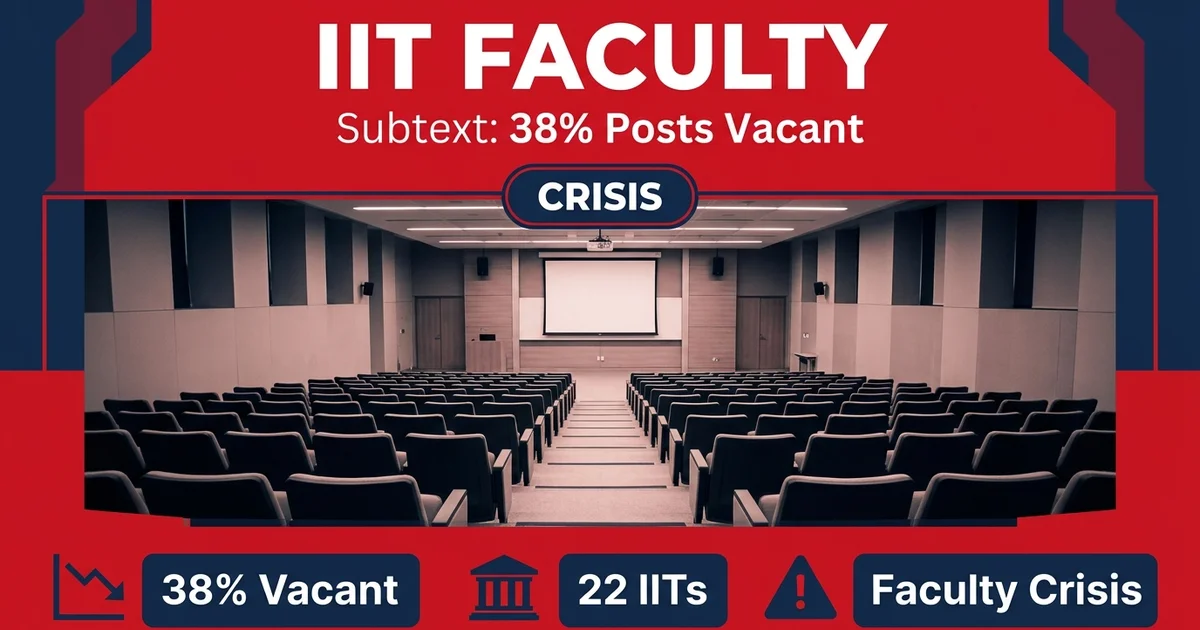
Your child dreams of studying at an IIT. You imagine world-class professors guiding them. But here is the harsh truth — 38% of faculty posts across 22 IITs are empty right now. The Indian Institutes of Technology are facing their worst faculty crisis in decades.
This is not a small number. Over 7,000 professor positions remain unfilled. The shortage affects teaching quality, research output, and student experience at India's most prestigious engineering institutions. Here is what is really happening and why it matters for your child's future.
What Is the IIT Faculty Shortage 2026?
The Ministry of Education recently shared data in Parliament. Across all 22 IITs in India, 38% of sanctioned faculty posts are vacant. That means for every 10 professors needed, only 6 are actually teaching.
The situation is worse at newer IITs. Some of these institutes have vacancy rates above 50%. The older IITs like Bombay, Delhi, and Madras are better off, but they too face significant shortfalls.
| Category | Status |
|---|---|
| Total IITs | 22 institutes |
| Sanctioned Faculty Posts | Approx. 19,000 |
| Vacant Posts | Over 7,000 (38%) |
| Worst Affected | Newer IITs (Bhilai, Dharwad, Jammu) |
| Student-Faculty Ratio | Over 20:1 in many IITs |
Always check the latest data at the official source: iit.ac.in
Why Are So Many IIT Faculty Posts Vacant?
The shortage did not happen overnight. Several deep-rooted problems have built up over years.
- Slow recruitment process: Hiring a professor at an IIT takes 12 to 18 months. Multiple committees, background checks, and bureaucratic approvals delay every appointment. Many candidates drop out and take private sector jobs.
- Low pay compared to industry: A fresh PhD graduate can earn Rs 25-40 lakh in the IT industry. An assistant professor at an IIT starts at Rs 10-15 lakh. The gap pushes talent away from academia.
- Retirements outpacing hires: Every year, hundreds of professors retire. New appointments do not keep up with the pace. The gap keeps growing.
- Limited PhD pipeline: India produces fewer quality PhDs than needed. Many IIT graduates prefer corporate careers over research and teaching.
- Location issues: Newer IITs are in smaller cities. Many professors prefer to stay in metros where their spouses can find jobs and children get better schools.
How Does Faculty Shortage Affect Students?
The impact is real and immediate. Students feel it in their daily college life.
- Larger class sizes: Instead of 30 students in a class, some IITs now have 80 to 100 students. Personal attention becomes impossible.
- Fewer elective courses: With fewer professors, many specialized courses are simply not offered. Students miss out on niche subjects.
- Delayed research guidance: PhD and MTech students wait months for supervisor allocation. Research timelines stretch beyond planned durations.
- Overburdened existing faculty: Professors handling extra courses and students burn out. Teaching quality suffers.
- Weaker industry connections: Faculty members drive industry collaborations. Fewer professors mean fewer internship and placement opportunities.
Which IITs Are Hit the Hardest?
Not all IITs face the same level of crisis. Newer institutes struggle the most.
| IIT | Approximate Vacancy Rate | Situation |
|---|---|---|
| IIT Bhilai | Above 55% | Critical |
| IIT Dharwad | Above 52% | Critical |
| IIT Jammu | Above 48% | Severe |
| IIT Palakkad | Above 45% | Severe |
| IIT Bombay | Around 25% | Moderate |
| IIT Delhi | Around 22% | Moderate |
Students who join newer IITs expecting the same quality as older ones often feel the difference immediately. The infrastructure may be new, but the teaching strength is not there yet.
What Is the Government Doing About It?
The Ministry of Education has taken several steps. But the results have been slow.
- Fast-track recruitment drives: IITs now hold special recruitment rounds to fill vacancies quickly. But the process still takes 6 to 12 months per batch.
- Increased sanctioned strength: The government has increased the total number of faculty posts. But sanctioned posts do not mean filled posts.
- Prime Minister's Research Fellowship: This scheme offers Rs 70,000 to Rs 1,20,000 per month to top PhD graduates who join IITs as faculty. It has attracted some talent, but not enough.
- Visiting faculty programmes: IITs invite industry experts and foreign professors for short-term teaching. This helps but does not solve the core problem.
- International faculty hiring: Some IITs are now recruiting professors from abroad. This is a positive step but remains limited in scale.
What This Means for Aspiring IIT Students
If your child is preparing for JEE, this crisis does not mean they should avoid IITs. The brand value, peer network, and placement records remain strong. But it does mean they should set realistic expectations.
Newer IITs may not offer the same mentorship experience as older ones. Students will need to be more self-driven. They should actively seek research opportunities, participate in projects, and build industry connections on their own.
The key is strong foundational preparation. Students who master the basics in school stand a better chance of thriving even with limited faculty support. This is where early coaching and exam preparation make a real difference.
What Comes Next — The Future Outlook
The IIT system is at a crossroads. Without dramatic changes, the shortage will worsen. Here is what experts suggest:
- Double the PhD output: India needs at least 10,000 quality PhDs per year from IITs and IISc to meet faculty demand.
- Raise academic salaries: Matching industry pay will attract more talented researchers to teaching.
- Simplify hiring rules: The current recruitment process is too slow and complex for modern academia.
- Expand visiting faculty: More industry professionals can teach part-time and bridge the gap.
- Better campus infrastructure: Newer IITs need better housing, schools, and lifestyle facilities to attract professors.
People Also Ask
Q: How many faculty posts are vacant in IITs in 2026?
Across 22 IITs, about 38% of sanctioned faculty posts are vacant. This means over 7,000 professor positions remain unfilled, affecting teaching quality and research output.
Q: Why are IITs facing a faculty shortage?
The shortage is caused by slow recruitment processes, low salaries compared to private sector, retirements outpacing new hires, and many qualified candidates preferring industry jobs over academia.
Q: Which IITs have the highest faculty vacancy rate?
Newer IITs like IIT Bhilai, IIT Dharwad, and IIT Jammu have vacancy rates above 50%. Older IITs like Bombay and Delhi have lower vacancy rates but still face significant shortfalls.
Q: How does faculty shortage affect IIT students?
Students face larger class sizes, fewer elective courses, delayed research guidance, and reduced mentorship. The student-to-faculty ratio has worsened to over 20:1 in many IITs.
Q: What is the government doing to fix the IIT faculty crisis?
The government has introduced fast-track recruitment, increased sanctioned strength, and offered attractive packages through the Prime Minister's Research Fellowship. But results have been slow so far.
The IIT faculty shortage is a serious challenge. With 38% of posts empty, India's best engineering institutes are struggling to deliver on their promise. The government must act faster. IITs must adapt their hiring. And students must be prepared to be more self-reliant than ever.
For parents in Amroha, Joya, and nearby areas whose children dream of IITs and other top institutions, strong early preparation is the foundation. JGPS (jgps.in) helps young students build the skills and confidence they need for competitive exams. Start early. Build strong basics. Visit jgps.in or call +91 9412137554 to learn more about our coaching programmes.