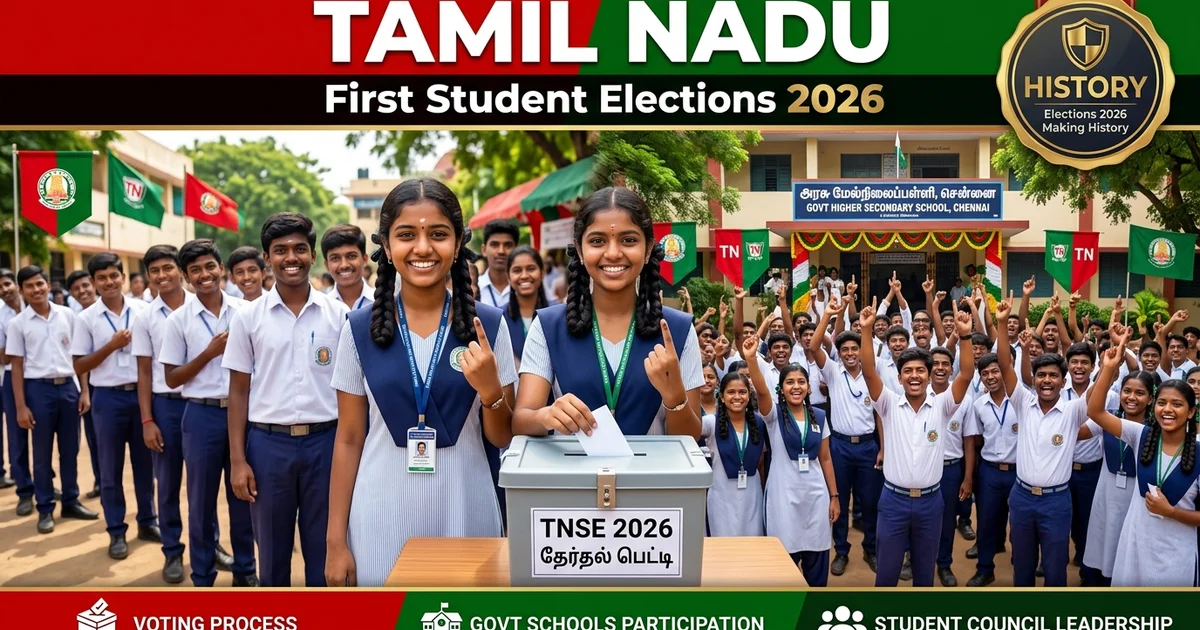
Imagine your child walking into school on election day. They hold a ballot paper, walk to a voting booth, and pick their favourite candidate. This is not a mock drill. Tamil Nadu student elections 2026 are happening in real government schools right now.
For the first time in history, Tamil Nadu government schools are holding proper student council elections. Over 30,000 schools across the state are participating. Students from Class 6 to Class 12 are voting to choose their school leaders. It is the biggest school democracy exercise India has ever seen.
What Happened — The Key Update Explained
The Tamil Nadu School Education Department issued an order in June 2026. It directed all government and government-aided schools to hold student council elections before July 15, 2026. The elections follow a clear set of rules.
Here is what makes these elections special:
- Real ballot voting: No online voting. Students use paper ballots just like adult elections
- Secret booths: Schools must set up enclosed voting booths to protect student privacy
- Student election officers: Senior students manage the polling process under teacher supervision
- Campaign period: Candidates get 5 days to campaign with posters, speeches, and rallies
- Code of conduct: No student can use force, threats, or gifts to win votes
The Department of School Education has published detailed guidelines on its official portal. You can read the full order at tnschools.gov.in.
Why This Matters — Impact on Students and Parents
Many parents ask: why hold elections in schools? The answer is simple. Children learn best by doing. Reading about democracy in a textbook is one thing. Standing in a voting line and making a choice is completely different.
Here is what your child gains from this experience:
| Skill | How Elections Help |
|---|---|
| Leadership | Students learn to lead teams, take responsibility, and represent others |
| Public speaking | Candidates must give speeches to their entire school |
| Decision making | Voters learn to choose leaders based on promises, not just popularity |
| Civic sense | Students understand how real elections and government work |
| Confidence | Standing for election builds courage to face challenges |
According to a 2025 NCERT report, students who participate in school-level democratic activities show 40% better civic awareness in Class 10 assessments. These elections are not just fun. They build skills that help your child in exams and in life.
What You Should Do Now — 5 Actions for Parents
- Talk to your child about elections: Explain what elections are and why they matter. Use simple words. Tell them how people choose leaders in India.
- Encourage participation: If your child wants to stand for election, support them. Help them prepare a speech. Practice in front of family members.
- Teach them to vote wisely: Tell your child not to vote for friends just because they are friends. Vote for the best candidate. Look at promises, not popularity.
- Discuss fair play: Explain that using force, threats, or bribes to win votes is wrong. A good leader earns respect, not fear.
- Connect it to entrance exams: Schools like Sainik School and Navodaya value leadership skills. Tell your child that this experience will help them in interviews and applications.
If your child is in Class 4 to 6 and preparing for entrance exams, leadership activities like student elections can strengthen their profile. JGPS coaching in Amroha includes personality development sessions that build the same confidence your child needs for elections and exams.
How Other States Compare — School Democracy in India
Tamil Nadu is not the first state to think about student elections. But it is the first to make them mandatory for all government schools. Here is how other states handle student councils:
- Delhi: Some schools have student councils, but elections are not mandatory
- Karnataka: Student councils exist in select government schools, but voting is not always secret
- Kerala: School elections happen in many schools, but rules vary by district
- Uttar Pradesh: Student councils are common in private schools but rare in government schools
Tamil Nadu stands out because the state government is treating student elections as seriously as adult elections. Secret ballots, polling booths, and election officers — all are part of the process.
What Comes Next — Future Outlook
If the Tamil Nadu student elections 2026 succeed, other states will likely follow. The Union Education Ministry has already expressed interest in a national framework for school student councils.
The Central Board of Secondary Education (CBSE) is also considering student council elections as part of its co-curricular assessment. This means your child's school election experience could soon count towards their final grades.
For parents in UP, Bihar, and Uttarakhand, this is a wake-up call. Start preparing your child now. Schools are changing. Exams are changing. Leadership and civic skills are becoming as important as marks.
Frequently Asked Questions
Q: What are the Tamil Nadu student elections 2026?
The Tamil Nadu student elections 2026 are the first-ever student council elections held in government schools across Tamil Nadu. Students from Class 6 to 12 will vote to elect their school leaders in July 2026.
Q: Who can vote in the Tamil Nadu school student elections?
Students from Class 6 to Class 12 studying in Tamil Nadu government and government-aided schools are eligible to vote. The elections follow a one-student-one-vote system.
Q: Why did Tamil Nadu start student elections now?
The Tamil Nadu government launched these elections to teach students about democracy, leadership, and civic responsibility from a young age. It aims to build future leaders who understand how democratic processes work.
Q: How are student elections conducted in TN schools?
Students fill nomination forms, give speeches, put up posters, and campaign. Then all eligible students cast votes using ballot papers. Results are announced the same day. The process mirrors real elections.
Q: Can parents support their children in school elections?
Yes. Parents can help children prepare speeches, practice public speaking, and understand election rules. Schools encourage parents to guide children without doing the work for them.
The Tamil Nadu student elections 2026 are a landmark moment in Indian education. For the first time, over 30,000 government schools are running full-scale democratic elections. This is more than a school activity. It is training for life.
Parents across India can take inspiration from this. Whether your child is preparing for a school election or a competitive entrance exam, the skills are the same — confidence, leadership, and the ability to think independently. At JGPS (jgps.in), we help students build these exact skills through our coaching programmes for Sainik School, Navodaya, AMU, and more. Call +91 9412137554 to learn how your child can benefit.