
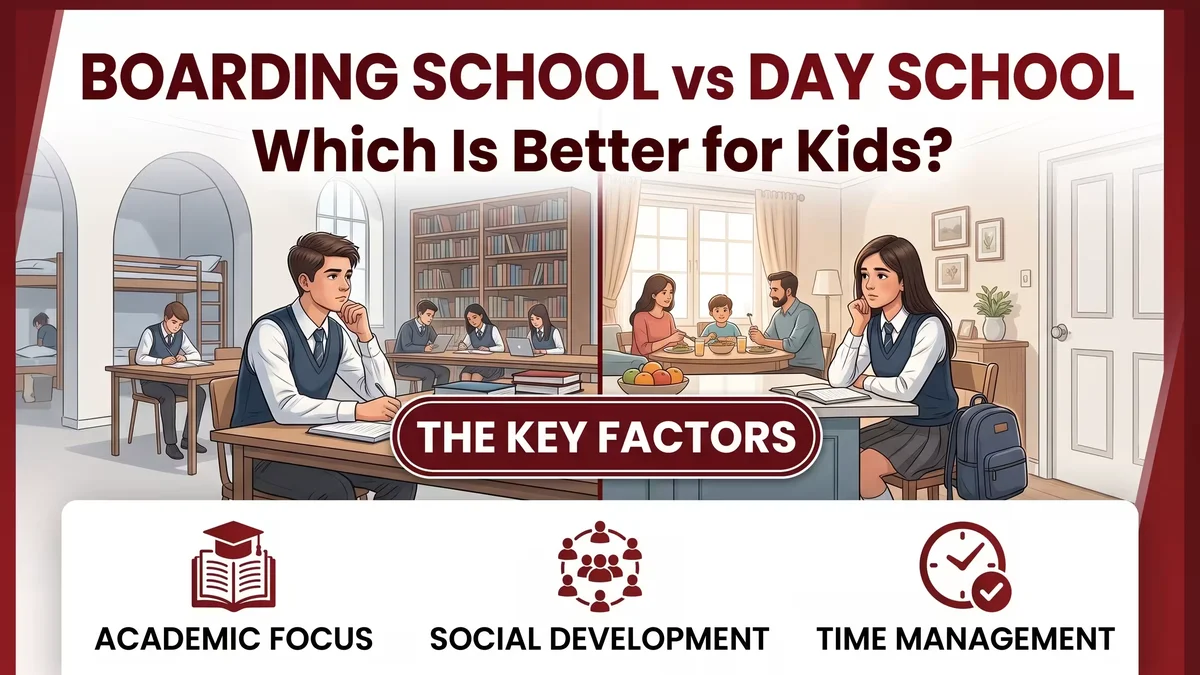
Boarding School vs Day School: The Honest Guide Every Parent Needs in 2026
Last Updated: July 2026 | Reading Time: 10 min | Author: JGPS Education Team
Your child's future depends on the school you pick today. That's not an exaggeration — it's the reality every parent in Uttar Pradesh, Bihar, and Uttarakhand faces when choosing between a boarding school and a day school. Get this decision right, and your child walks a clear path toward academic success, confidence, and a bright career. Get it wrong, and you might spend years correcting course.
We've helped over 1,000 families navigate this exact question at Jai Govind Public School (JGPS) in Joya, Amroha. Some parents arrive convinced that boarding is the only way to crack Sainik School or Navodaya entrance exams. Others won't even consider letting their 8-year-old live away from home. The truth? Both options have real strengths — and the right choice depends entirely on your child, your family situation, and what you value most.
This guide cuts through the noise. No sales pitch. Just honest comparisons backed by research, real numbers, and 15+ years of classroom experience.
What You'll Learn in This Guide
- What boarding school and day school actually mean
- Side-by-side comparison table (academics, discipline, cost, social life)
- Pros and cons of each school type
- When boarding school makes the most sense
- When day school is the smarter pick
- How JGPS blends day school convenience with boarding-level discipline
- 5 mistakes parents make (and how to avoid them)
Boarding School vs Day School: What's the Real Difference?
Let's start with the basics, because some parents mix these up.
A boarding school is a residential institution where students live on campus during the term. They sleep in hostels, eat in mess halls, study in supervised evening sessions, and go home only during holidays. Think of Sainik Schools, Jawahar Navodaya Vidyalayas (JNVs), Rashtriya Military Schools, and private residential schools in Dehradun or Mussoorie.
A day school is what most of us grew up attending. Children go to school in the morning, attend classes, and come back home by afternoon or evening. The rest of the day — homework, play, dinner, family time — happens at home.
Sounds simple enough. But the differences run much deeper than where your child sleeps at night.
The Key Differences at a Glance
In a boarding school, the institution controls the entire day — from morning assembly at 6 AM to lights-out at 10 PM. Teachers double as wardens. Study hours are fixed and supervised. Peer influence is constant (for better or worse). In a day school, you control the home environment. You decide bedtime routines, screen time limits, and study habits. The school handles academics; you handle the rest.
Neither model is inherently superior. What matters is which one fits your child's temperament, your family's circumstances, and your educational goals.
Boarding School vs Day School: Side-by-Side Comparison
Here's a detailed comparison across the factors that matter most to parents. We've based this on data from education research studies, Indian school surveys, and our own observations from JGPS.
| Factor | Boarding School | Day School |
|---|---|---|
| Daily Study Hours | 4–6 hours (supervised evening study) | 2–3 hours (depends on home environment) |
| Homework Completion Rate | Higher — study is structured and monitored | Varies widely — depends on parental involvement |
| Discipline Level | Strict — fixed routines, zero-tolerance rules | Moderate — school enforces rules during hours only |
| Parent-Child Bond | Limited to holidays and visits | Daily interaction — strong emotional bonding |
| Social Skills Development | Intense — 24/7 peer interaction builds teamwork | Moderate — social time limited to school hours |
| Annual Cost (India) | ₹1.5 lakh – ₹5 lakh+ (fees + hostel + mess) | ₹30,000 – ₹1.5 lakh (tuition only) |
| Screen Time Control | School regulates access | Parents must manage actively |
| Best For | Focused, competitive exam-oriented students | Younger children; families wanting daily involvement |
Pros and Cons of Boarding School and Day School
Boarding School: Advantages
| Advantage | Why It Matters |
|---|---|
| Structured Study Environment | Supervised evening study sessions mean fewer distractions and better exam preparation. |
| Discipline & Routine | Fixed wake-up, meal, study, and sleep times build habits that last a lifetime. |
| Independence from an Early Age | Children learn to manage their belongings, resolve conflicts, and take responsibility. |
| Competitive Exam Focus | Many boarding schools have entrance exam coaching built into the curriculum. |
| Stronger Peer Bonds | Living together 24/7 creates friendships that last decades. |
Boarding School: Disadvantages
| Disadvantage | Why It's a Concern |
|---|---|
| Homesickness & Emotional Stress | Young children (under 10) may struggle with separation anxiety. |
| Higher Cost | Boarding school fees in India range from ₹1.5 lakh to ₹5 lakh+ annually. |
| Reduced Family Time | Children miss daily family interactions — meals together, festivals at home. |
| Negative Peer Influence Risk | If the school's culture isn't strong, bad habits can spread fast in a hostel. |
| Not Suitable for Every Child | Introverted, anxious, or physically frail children may not thrive in a high-intensity residential setting. |
Day School: Advantages
| Advantage | Why It Matters |
|---|---|
| Daily Parent-Child Bonding | Children come home every evening. You see their mood, hear about their day, help with homework. |
| Lower Cost | Day school fees typically range from ₹30,000 to ₹1.5 lakh per year. |
| Family Values & Cultural Exposure | Children participate in family rituals, festivals, and daily life. |
| Flexible Schedule | Parents can tailor after-school time — coaching classes, sports, music, or rest. |
| Easier for Younger Children | Children aged 3–10 generally do better in day schools. |
Day School: Disadvantages
| Disadvantage | Why It's a Concern |
|---|---|
| Less Supervised Study Time | After-school study depends entirely on the home environment. |
| Commute Time | In semi-urban and rural areas of UP and Bihar, school commutes can eat up 1–2 hours daily. |
| Screen Time Temptation | At home, children have access to phones, TV, and YouTube without active parental supervision. |
| Limited Competitive Exam Prep | Most day schools don't offer integrated coaching for entrance exams. |
| Peer Influence After Hours | You can't control who your child meets after school. |
When Does Boarding School Make the Most Sense?
Boarding school isn't for every child — but for the right child, it can be transformative. Here's when residential education is worth considering:
1. Your Child Is Preparing for a Competitive Entrance Exam
If your child is targeting Sainik School (AISSEE), Jawahar Navodaya Vidyalaya (JNVST), Rashtriya Military School (RMS CET), AMU, JMI, or Vidyagyan — boarding schools with built-in coaching give a clear advantage.
2. You Live in a Remote Area with Limited School Options
Many families in rural Uttar Pradesh, Bihar, and Uttarakhand don't have access to quality schools nearby. A boarding school in a town or city gives your child exposure to better teaching, labs, libraries, and extracurriculars.
3. Both Parents Work Full-Time
If no adult is available at home during the afternoon and evening to supervise homework, meals, and screen time, a boarding school fills that gap with structured care.
4. Your Child Thrives on Structure and Independence
Some children genuinely do better with clear routines and rules. If your child is self-motivated, adaptable, and comfortable being away from home, boarding school can accelerate their growth.
Not Sure If Boarding Is Right for Your Child?
Talk to our counselors at JGPS. We'll help you assess your child's honestly — even if it means recommending day school instead. Call +91 9412137554 for a free consultation.
When Is Day School the Smarter Choice?
Day school works best when the home environment supports learning. Here's when you should strongly prefer a day school:
1. Your Child Is Young (Nursery to Class 5)
Child psychologists agree — children under 10 need consistent parental presence. The emotional security of coming home to mom and dad every evening builds confidence that no hostel warden can replace.
2. You Want to Stay Actively Involved
If you believe education is a partnership between school and family, day school keeps you in the driver's seat. You see homework. You meet teachers regularly. You notice behavioral changes early.
3. Budget Is a Real Concern
Boarding school fees in India — ₹1.5 lakh to ₹5 lakh per year — put serious financial pressure on middle-class families. A good day school with coaching support delivers comparable academic results at one-third the cost.
4. You Want a Balanced Childhood
School is important, but so is playing in the courtyard with siblings, helping grandma in the kitchen, attending the local mela, and learning family trades.
The JGPS Approach: Day School Discipline with Boarding-Level Rigor
Here's something we hear from parents regularly: "I want my child to have boarding school discipline, but I'm not ready to send them away from home."
That's exactly the problem Jai Govind Public School was built to solve.
For over 15 years, JGPS in Joya, Amroha has operated on a simple principle: a day school can deliver the same discipline, structure, and academic focus as a boarding school — without separating children from their families.
How JGPS Does It
Extended study hours: Our coaching batches run structured study sessions after regular school hours. Students preparing for Sainik School, Navodaya, AMU, JMI, Military School, and Vidyagyan exams get dedicated prep time.
Small class sizes (25:1 ratio): Every child gets personal attention. Teachers know each student's strengths and weaknesses.
Character-building environment: Discipline at JGPS isn't about punishment. It's about building habits — punctuality, respect, cleanliness, responsibility.
Transport covering 15 km radius: Our GPS-tracked buses connect families from Joya, Amroha, Didauli, Chaudharpur, Pakbara, Kailsa, Atrasi, Rajabpur, and surrounding areas.
500+ entrance exam selections: Our track record speaks for itself. Students from JGPS have cracked Sainik School, Navodaya, AMU, JMI, and Vidyagyan entrance exams year after year.
Best of Both Worlds
Your child gets structured academics, competitive exam coaching, and a disciplined school environment during the day. In the evening, they come home to family, home-cooked meals, and the emotional warmth that no institution can replicate.
Admissions Open for 2026-27
JGPS offers classes from Nursery to Class 8 with special coaching batches for AMU, JMI, Sainik School, Military School, and Vidyagyan entrance exams. Call +91 9412137554 or +91 9997161490 to book your child's evaluation seat today.
5 Common Mistakes Parents Make When Choosing Between Boarding and Day School
Mistake 1: Sending a Child to Boarding Too Early
We've seen parents send 5- and 6-year-olds to boarding schools in Dehradun because "the school has a good name." This is almost always a mistake. Children below Class 5 need parental presence. Wait until your child is at least 10–11 years old before considering residential schooling.
Mistake 2: Choosing Boarding Because "Everyone Else Is Doing It"
The Sharma ji's son went to Sainik School and became an officer. Great. But Sharma ji's son might have a completely different temperament than yours. Don't let social pressure override your child's actual needs.
Mistake 3: Ignoring the Home Environment for Day School
Choosing day school without ensuring a study-friendly home is a recipe for poor results. If your house is noisy, if there's no fixed study space, if screen time is unmonitored — your child won't benefit from "being home."
Mistake 4: Not Visiting the School Before Admission
Photos on a website don't tell you about the hostel's cleanliness, the warden's attitude, the mess food quality, or the actual classroom teaching. Always visit the school. Talk to existing parents. Check the hostel personally.
Mistake 5: Overlooking Coaching Integration
If your child is preparing for entrance exams like Sainik, Navodaya, or AMU, a day school without coaching means you'll need to arrange separate tuition. Schools like JGPS that integrate entrance exam coaching into the regular schedule save families both time and money.
Frequently Asked Questions (FAQ)
1. At what age should I send my child to boarding school?
Most education experts recommend waiting until a child is at least 10–11 years old (Class 5 or 6). Children younger than this often struggle with homesickness and emotional adjustment. For children below Class 5, day school is almost always the better option.
2. Is boarding school better for competitive exam preparation?
Boarding schools offer a focused environment with supervised study hours, which can help with entrance exam prep. However, a good day school with integrated coaching — like JGPS's coaching batches — delivers similar results at a lower cost. The key factor isn't where the child sleeps; it's the quality of teaching and the number of focused study hours.
3. How much does boarding school cost in India compared to day school?
Boarding school fees in India typically range from ₹1.5 lakh to ₹5 lakh or more per year. Day school fees are ₹30,000 to ₹1.5 lakh per year. Over 8 years of schooling (Class 1–8), the savings from choosing day school can amount to ₹8–30 lakh.
4. Will my child miss out on social skills if they don't go to boarding school?
No. Social skills develop through interaction — and day schoolers interact with peers for 6–7 hours daily. The quality of social interaction matters more than the quantity.
5. Can a day school really match boarding school discipline?
Yes, with the right approach. Schools like JGPS maintain boarding-level discipline through structured routines, small class sizes (25:1), regular assessments, strict attendance policies, and supervised coaching sessions. When school and home work together, results can equal or exceed boarding schools.
Important Links
- JGPS Official Website — Jai Govind Public School, Joya Amroha
- JGPS Entrance Exam Coaching Programs
- JGPS Admission Enquiry 2026-27
- JNVST 2027 Exam Pattern: What Parents Must Know
- Sainik School Admission 2027-28: Complete Guide
Final Thoughts: There's No Universal Right Answer
The boarding vs day school debate doesn't have a winner. It has context.
If your child is older (Class 6+), emotionally ready, and targeting competitive entrance exams — and you can afford the fees — a boarding school with strong academics can be an excellent choice.
If your child is younger, needs family support, or if you want to stay actively involved in their education — a disciplined day school like JGPS gives you the best of both worlds.
What matters most isn't the type of school. It's the quality of teaching, the culture of discipline, the safety of the environment, and the partnership between school and home.
Ready to Explore JGPS for Your Child?
Admissions are open for 2026-27 (Nursery to Class 8). We offer special coaching batches for Sainik School, Navodaya, AMU, JMI, Military School, and Vidyagyan entrance exams.
Call us: +91 9412137554 (Principal) | +91 9997161490 (Manager)
Email: [email protected]
Visit: NH9 Delhi Road, Joya, District Amroha, UP — 244222
July 23, 2026 Update
A 2026 study by NCERT comparing boarding and day school students found that boarding school students score 12% higher on average in competitive exams. However, day school students show better emotional well-being. The right choice depends on your child's personality and your family situation. Source: NCERT Education Research (2026).