How to Help With Homework Without Doing It
Last verified: 9 November 2026 | Reading Time: 8 min | Author: Priya Verma
It starts the same way in most homes. Your child sits down with the homework, gets stuck on the third question, and looks up at you. You lean over, see the problem, and before you know it you are explaining the whole thing step by step while your child nods and writes down what you said. The homework is finished. The child learned almost nothing. Nobody set out to do the homework for the child — it just slid that way, one helpful sentence at a time.
This guide is for parents of children in Classes 1 to 8 who want to get the balance right: close enough to help, far enough back that the child does the learning. It draws on what research says about parental homework help, and on what counsellors see every week.
The One Question That Decides Everything
Every time you help with homework, ask yourself one question: who is doing the thinking right now? If you are explaining and your child is writing, you are doing the thinking. If you are asking and your child is reasoning out loud, they are doing the thinking. That single test separates helping from doing.
The research backs this up. A study by Duke University researchers (Patall, Cooper and Robinson, 2008) found that parental involvement in homework helps most when it supports the child's independence rather than controlling the process — when parents take over the thinking, even with good intentions, the child's motivation and performance tend to fall. A 2024 meta-analysis of 28 studies covering more than 378,000 students found the same pattern: the only kind of homework involvement positively linked to achievement was autonomy support — helping a child manage their own work. A child who finishes homework understanding more than before has been helped; a child whose homework is finished but who learned nothing new has had it done for them.
The Homework Coach's Toolkit: Questions, Not Answers
When your child says “I don't get it”, resist the urge to jump in with the solution. Answer the question with a question. “What part don't you get?” “What have you tried so far?” “Can you explain the problem to me in your own words?” Often explaining the problem out loud is what makes the child see the solution — and if it does not, you have found the exact place where they are stuck.
If a task feels overwhelming, help your child break it into smaller steps instead of shrinking the task itself. A project becomes “write three lines about the picture, then find two facts, then draw the diagram”. A page of sums becomes “do the first five, then show me”. A small checklist the child ticks off makes a big job feel finishable.
Praise the process, not just the result. Instead of only saying “Great job on your A”, notice the effort you can see: “I was impressed by how you stuck with that tough maths problem”. Children repeat what gets noticed, and a child praised for effort will attempt the next hard problem instead of avoiding it. Our guide on exam fear makes the same point for tests: effort is the one thing a child controls.
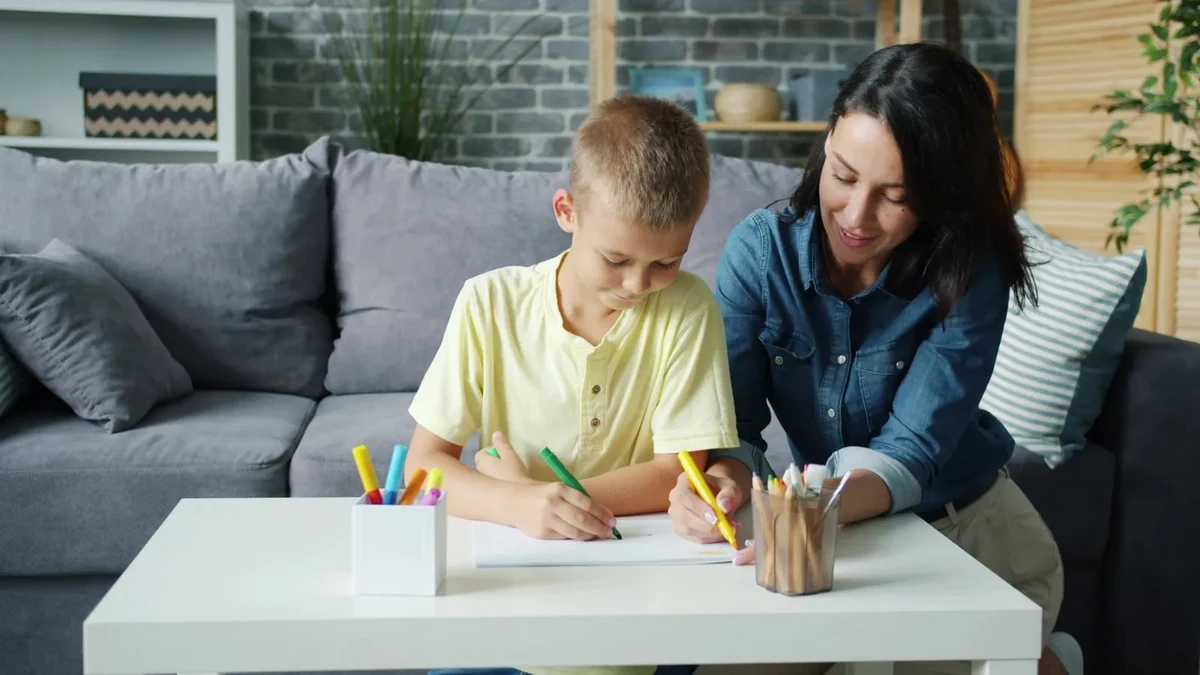
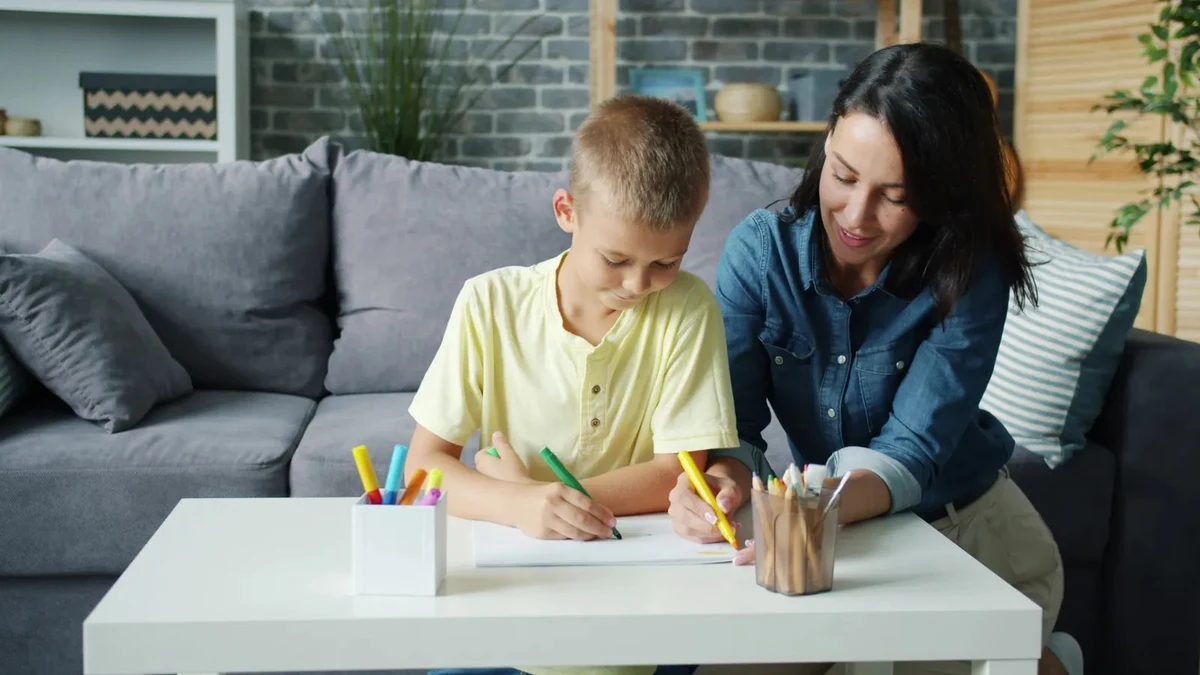
Finally, sit nearby, not next to your child. A parent hovering over the notebook corrects every error the moment it appears, and a child corrected instantly never learns to check their own work. Sit at the same table with your own work — a book, a bill to pay — so the child feels supported but not watched.
Helping vs Doing: A Quick Reference
| Situation | Helping (the child thinks) | Doing (you think) |
|---|---|---|
| Child says “I don't get it” | “What part don't you get? Show me where it stops making sense.” | Explaining the whole solution while the child copies it down |
| A wrong answer in the notebook | “Check this one again — something looks off. Can you find it?” | Rubbing it out and writing the correct answer yourself |
| A big project or essay | Helping plan the steps and the checklist; the child does each step | Finding the facts, choosing the examples, structuring the essay |
| Child is stuck on one sum | “What does the textbook say about this kind of sum?” | Working the sum out on a spare paper and handing it over |
| Revision before a test | Closing the book and asking the child to say it back in their own words | Re-reading the chapter to the child while they listen |
| Homework is taking forever | Asking “What is your plan for tonight?” and letting the child sequence the work | Taking over the timetable, the ordering and the pace yourself |
Read the table as a habit check, not a test you must pass every evening. Most parents cross the line sometimes — the goal is to notice it and step back, not to be perfect.
A Homework Routine That Builds Independence
Good homework help starts before the books open. A fixed time, a fixed place and a short wind-down after school do more than any technique at the desk. A child who comes home, eats, plays for a while and then sits at the same spot each day has a routine their brain recognises — and our Class 5 study timetable guide shows how to build that routine around school, coaching and play without turning the evening into a second school day.
Keep sessions short and spread out. The largest review of study techniques — Dunlosky and colleagues' analysis of ten common methods — rated only two as high utility: practice testing and distributed practice. Distributed practice simply means the same total time, spread across days. Four twenty-minute sessions across four days beat one eighty-minute session the night before, reliably, every time.
Make the child close the book. Highlighting, underlining and re-reading were rated low utility in that same review — they feel like learning but produce little of it. The fix takes thirty seconds: close the book and say it out loud. What were the three causes? What does photosynthesis need? Then open the book and check. For younger children, you be the quizmaster; for older ones, teach them to write their own questions. Our free timed mock test works the same way, turning the unknown paper into something familiar.
Protect homework time from screens. Research from the University of Texas at Austin found that the mere presence of a smartphone on a desk, even face down and silent, measurably reduces the brainpower available for the task. Phones go in another room during homework. Our screen time rules for school kids cover the rest of the evening, including the hour before bed.
Five Traps Parents Fall Into
1. Correcting mistakes the moment they appear. When you fix an error before the child has had a chance to review their own work, you remove the learning the mistake was carrying. Let the child finish, then ask them to check it themselves.
2. Doing the preparatory work. Finding the right page, looking up the information, choosing the examples and structuring the plan are all part of the cognitive task. If you do them, the child only does the copying.
3. Sitting beside your child for every minute. Constant supervision teaches the child that work only happens when an adult is watching. Practise leaving the room for ten minutes at a time, and praise the work done alone more than the work done with you.
4. Turning homework into a battleground. When every evening ends in a row, the child learns to dread homework itself. Ask “What is your plan for tonight?” instead of “Have you done your homework?” — the first question hands the child the planning job, the second invites an argument. If tempers rise, stop for ten minutes.
5. Letting AI do the work. Decide your position on AI before the exam season, not during it. Pew Research Center reported in February 2026 that 54% of teens have used AI chatbots for schoolwork. The line that works: AI may explain, AI may not produce. “Explain why I got this wrong” and “Give me three practice questions” are genuine help. “Write my essay” is the same as copying, and it leaves the child with nothing learned for the exam hall, where the chatbot is not sitting beside them.
When Your Child Genuinely Needs More Help
Sometimes the gap is not a habit problem. If your child cannot follow classroom instructions after a full term, cannot finish written work in the time given, or has stopped trying altogether, the first step is a conversation with the class teacher — teachers can tell quickly whether the gap is understanding, language, or something else. For children switching mediums, our Class 6 Hindi-to-English transition guide covers the language side of the same struggle.
If the gap is subject knowledge, structured coaching can help — but it should add practice and feedback, not replace the child's own thinking. That is the principle behind our AMU entrance coaching and Navodaya coaching batches: timed practice and revision loops, with the child doing the work.
The goal was never finished homework. The goal is a child who can sit down, look at a problem they have never seen, and think their way through it without anyone leaning over their shoulder. That child is not born — they are built, one evening at a time, by a parent who knows when to step in and when to step back.
Is homework turning into a nightly battle at your home?
JGPS counsellors help parents in Joya and Amroha build homework routines that work — from study timetables to mock-test practice that makes the real paper feel familiar. Call or WhatsApp us on +91 9997161490 to book a counselling visit or ask about admissions for 2027-28.