Your child cleared the AISSEE written exam. The medical test went well. Now comes the final hurdle — the Sainik School interview. This is where many students fail. Not because they are not smart. But because they are not prepared for what the panel asks. The interview tests confidence, communication, general awareness, and whether your child truly wants to join a military school.
This guide has 50+ real interview questions with answers. What the panel looks for. How to prepare. Common mistakes. Everything you need to help your child succeed.
What Happens in the Sainik School Interview?
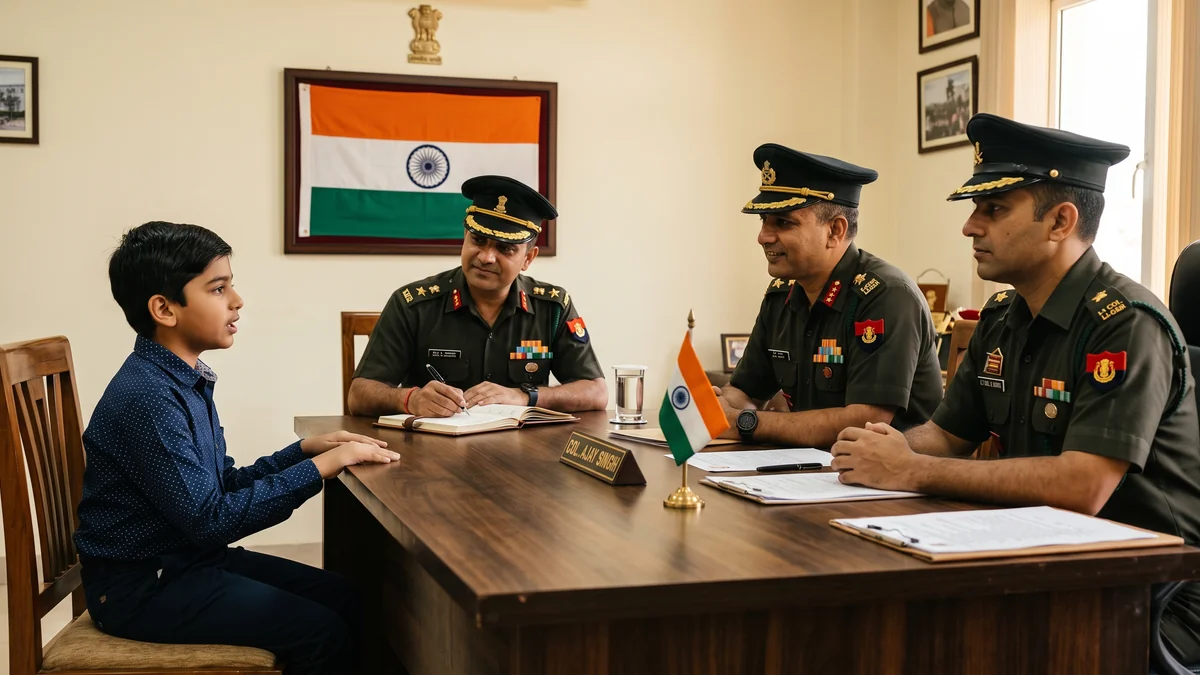
The interview is conducted by a panel of 3-4 officers. Usually, it includes the school principal, a senior teacher, and sometimes a military officer. The interview lasts 10-15 minutes. Your child will be asked 8-12 questions.
The panel is not looking for perfect answers. They want to see if your child is confident, honest, and genuinely interested in joining Sainik School. They check body language, eye contact, clarity of speech, and how your child handles pressure.
📌 Did You Know?
Approximately 20-25% of students who clear the written exam and medical test get rejected in the interview. The most common reasons are poor confidence, inability to answer basic questions, and lack of eye contact. Practice makes perfect.
50+ Sainik School Interview Questions with Answers
Personal Questions (Questions 1-15)
1. Tell me about yourself.
Good answer: "Good morning, Sir. My name is [Your Name]. I am [age] years old. I study in Class [X] at [School Name] in [City]. My father is a [occupation] and my mother is a [occupation/homemaker]. I like playing cricket and reading books. I want to join Sainik School because I want to serve my country and become an army officer."
2. Why do you want to join Sainik School?
Good answer: "I want to join Sainik School because I want to serve in the Indian Army. Sainik School will give me the right training, discipline, and education to achieve my dream. I want to make my parents and country proud."
3. What does your father do?
Good answer: "My father is a [farmer/teacher/businessman/government employee]. He works very hard to support our family. He has taught me the value of hard work and honesty." — Be honest. Do not lie about your family background.
4. What does your mother do?
Good answer: "My mother is a [homemaker/teacher/nurse]. She takes care of our family and helps me with my studies. She has taught me to be respectful and hardworking."
5. How many siblings do you have?
Good answer: "I have [one brother/sister/no siblings]. My [brother/sister] studies in Class [X] at [School]." — Keep it simple and honest.
6. Which is your favorite subject and why?
Good answer: "My favorite subject is [Math/Science/English]. I like it because [specific reason — e.g., 'Math helps me solve problems logically' or 'Science teaches me how the world works']."
7. What are your hobbies?
Good answer: "I like playing cricket, reading books, and helping my mother at home. I also enjoy solving puzzles and watching army-related shows." — Choose hobbies that show discipline and learning.
8. Who is your role model and why?
Good answer: "My role model is [Captain Vikram Batra/Abdul Kalam/your father/a teacher]. I admire them because [specific reason — e.g., 'Captain Batra showed great courage in the Kargil War' or 'APJ Abdul Kalam worked hard from a small village to become the President']."
9. What do you do in your free time?
Good answer: "In my free time, I play cricket with my friends, read books, and help my parents. I also practice puzzles and reasoning questions."
10. Are you nervous right now?
Good answer: "A little bit, Sir. But I am also excited because this is an important opportunity for me. I have prepared well and I am confident." — Being honest about nervousness shows maturity.
General Knowledge Questions (Questions 11-25)
11. What is the capital of India?
Answer: New Delhi.
12. Who is the President of India?
Answer: Droupadi Murmu (as of 2026). — Always check the latest information before the interview.
13. Who is the Prime Minister of India?
Answer: Narendra Modi.
14. What is the name of our national anthem?
Answer: Jana Gana Mana. It was written by Rabindranath Tagore.
15. What is the name of our national flag?
Answer: Tiranga. It has three colors — saffron (courage), white (peace), and green (prosperity). The Ashoka Chakra in the center has 24 spokes.
16. How many states are there in India?
Answer: 28 states and 8 union territories.
17. What is the largest state in India?
Answer: Rajasthan (by area). Uttar Pradesh is the largest by population.
18. What is the currency of India?
Answer: Indian Rupee (INR). The symbol is ₹.
19. Who was the first President of India?
Answer: Dr. Rajendra Prasad. He served from 1950 to 1962.
20. What is the full form of NDA?
Answer: National Defence Academy. It is located in Khadakwasla, Pune. This is where Sainik School students aim to go after Class 12.
21. What is the full form of AISSEE?
Answer: All India Sainik Schools Entrance Exam. This is the exam your child has already cleared.
22. What are the three wings of the Indian Armed Forces?
Answer: Indian Army, Indian Navy, and Indian Air Force.
23. What is the national animal of India?
Answer: Bengal Tiger (Royal Bengal Tiger).
24. What is the national bird of India?
Answer: Indian Peacock.
25. What is the national game of India?
Answer: Hockey. (Note: Cricket is the most popular sport, but Hockey is the national game.)
Sainik School Specific Questions (Questions 26-40)
26. How many Sainik Schools are there in India?
Answer: There are 50 Sainik Schools in India — 33 original schools plus 17 new ones established recently.
27. What is the aim of Sainik School?
Answer: The aim of Sainik School is to prepare students for the National Defence Academy (NDA) and to build discipline, leadership, and physical fitness among young students.
28. What time does a Sainik School student wake up?
Answer: Students wake up at 5:00 AM. Physical training starts at 5:30 AM. The day is very structured and disciplined.
29. What is NDA and why is it important?
Answer: NDA stands for National Defence Academy. It is the training academy for officers of the Indian Army, Navy, and Air Force. After Class 12, Sainik School students appear for the NDA exam. This is the path to becoming a military officer.
30. What sports are played at Sainik School?
Answer: Sainik Schools offer football, cricket, basketball, volleyball, athletics, swimming, and horse riding. Physical fitness is a major part of the curriculum.
31. Can girls join Sainik School?
Answer: For Class 6, currently only boys can apply. For Class 9, both boys and girls are eligible. The government is planning to expand girls' admission in the future.
32. Which Sainik School is nearest to your home?
Answer: Research this before the interview. For UP students, Sainik School Amaravat, Sainik School Bijapur, or Sainik School Rewa may be options. Know the name and location of your preferred school.
33. What will you do if you do not get selected in Sainik School?
Good answer: "I will try again next year. I will work harder on my weaknesses and prepare better. I will not give up on my dream of serving the country." — Show determination, not disappointment.
34. What do you know about the Indian Army?
Good answer: "The Indian Army is one of the largest armies in the world. It protects our country from enemies. Indian Army soldiers have shown great bravery in wars like Kargil, 1971, and 1965. I want to serve in the Indian Army and protect my country."
35. Who is the Chief of Army Staff?
Answer: Check the latest appointment before the interview. As of 2026, the information may change. Always verify current officials.
Situational & Personality Questions (Questions 36-50)
36. What are your strengths?
Good answer: "I am hardworking, I listen carefully, and I never give up. When I have a difficult problem, I keep trying until I solve it. My teachers say I am well-behaved and punctual."
37. What are your weaknesses?
Good answer: "I sometimes spend too much time on one problem instead of moving on. I am working on this by setting time limits for myself during practice." — Be honest but show you are improving.
38. If a senior student bullies you, what will you do?
Good answer: "I will first try to handle it calmly. If it continues, I will report to my teacher or warden. I believe in solving problems through communication, not fighting."
39. Can you live away from your family?
Good answer: "Yes, Sir. I understand that Sainik School means living away from family. I am ready for this. I want to become independent and learn to take care of myself. My parents support my decision."
40. What will you do if you miss your parents at Sainik School?
Good answer: "I will focus on my studies and sports. I will make new friends. I know my parents want the best for me, and that gives me strength. I will write letters to them and meet them during holidays."
41. Describe your daily routine.
Good answer: "I wake up at 6 AM, brush my teeth, and do some exercise. Then I get ready for school. After school, I play for one hour. Then I study for 2-3 hours. I have dinner with my family and sleep by 10 PM."
42. What is the meaning of your name?
Good answer: Know the meaning of your own name. If it has a special story from your parents or grandparents, share it briefly.
43. Have you heard about any recent news? What is it?
Good answer: Read 2-3 current news stories before the interview. Talk about something relevant — a sports victory, a space mission, or an army achievement. Example: "India recently launched a new satellite. I read about it in the newspaper."
44. Draw the Indian flag from memory.
Tip: Sometimes the panel asks students to draw or write something. Practice drawing the Indian flag at home. Remember: saffron on top, white in the middle, green at the bottom, Ashoka Chakra in the center with 24 spokes.
45. Sing the national anthem.
Tip: Practice singing Jana Gana Mana at home. Know all the words. Sing with confidence and stand straight while singing.
46. Do you have any questions for us?
Good answer: "Yes, Sir. What advice would you give to a new student joining Sainik School?" — Asking a question shows genuine interest.
47. What will you do if you get hurt during sports?
Good answer: "I will inform my teacher or coach immediately. I will go to the school medical room. Small injuries are normal in sports. I will not be scared."
48. How will you manage studies and sports together?
Good answer: "I will follow a daily routine. Time management is the key. Sports keep me fit and focused. Studies give me knowledge. I will balance both by planning my day properly."
49. What is the motto of Sainik School?
Answer: "Nurture and Courage" (for newer schools) or the school-specific motto. Research the specific school your child is applying to.
50. Is there anything else you want to tell us?
Good answer: "Sir, I want to say that I am very serious about joining Sainik School. I have prepared hard for the written exam and I am ready for the discipline and challenges. Thank you for this opportunity."
How to Prepare Your Child for the Interview
2 Weeks Before the Interview
- Practice introduction daily: Your child should be able to introduce themselves in 30-45 seconds without hesitation. Practice every morning.
- Read 1 newspaper daily: Focus on national news, sports, and current affairs. The panel may ask about recent events.
- Study GK questions: Use this article as a reference. Ask your child 10 questions daily.
- Mock interviews: Sit as a panel and ask your child questions. Record them on video. Watch together and improve.
- Body language practice: Teach your child to sit straight, make eye contact, and speak clearly. No fidgeting or looking at the floor.
Interview Day Tips
- Dress neatly: Clean ironed clothes. Polished shoes. Neatly combed hair. No fancy clothes — simple and presentable.
- Reach early: Reach the venue 30 minutes before the scheduled time. Being late creates a bad impression.
- Greet the panel: Walk in confidently. Say "Good morning, Sir" or "Good afternoon, Sir" with a smile. Stand straight until told to sit.
- Do not panic: If you do not know an answer, say "I am sorry, Sir. I do not know." Do not guess or make up answers.
- Speak clearly: Do not mumble. Speak loudly enough for the panel to hear. Do not rush through answers.
7 Mistakes That Get Students Rejected in Interview
- No eye contact: Looking at the floor or ceiling shows lack of confidence. Look at the panel member who is speaking.
- Mumbling or speaking too fast: Speak clearly and at a moderate pace. Take a breath before answering.
- Lying about family background: The panel can easily verify information. Always be honest about your family and background.
- Not knowing basic GK: Questions about the President, Prime Minister, national symbols are basic. If you do not know these, it shows poor preparation.
- Copying other students: Every answer should be personal and genuine. Do not memorize robotic responses.
- Being overconfident: Confidence is good. But arrogance is not. Be respectful and humble.
- Not asking any question: When the panel asks "Do you have any questions?", always ask something. It shows genuine interest.
People Also Ask
Q: What questions are asked in Sainik School interview?
The panel asks about personal details, family background, school, hobbies, general knowledge, current affairs, why you want to join Sainik School, and basic subject questions. They also check confidence, communication, and body language.
Q: How long is the Sainik School interview?
The interview typically lasts 10 to 15 minutes. The panel asks 8-12 questions. Your child should be calm, confident, and speak clearly. Do not rush answers.
Q: Is interview compulsory for Sainik School admission?
Yes. After clearing the written exam (AISSEE) and medical test, the interview is the final round. It carries significant weight in the final selection. Many students who clear written and medical get rejected in the interview.
Q: How should my child introduce themselves in Sainik School interview?
Your child should say their full name, class, school name, city, parents' names and occupations, hobbies, and why they want to join Sainik School. Keep it under 30-45 seconds. Practice this introduction at home daily.
Q: Can Hindi medium students clear Sainik School interview?
Yes. The interview can be conducted in Hindi or English. What matters is confidence and clarity of thought. If your child can express themselves well in Hindi, that is perfectly fine. Practice speaking in front of family members.
The Sainik School interview is not about perfect English or big vocabulary. It is about confidence, honesty, and genuine interest. Your child should speak from the heart. Practice daily for 2 weeks before the interview. Focus on introduction, GK, and body language. Mock interviews at home are the best preparation.
If you live in Amroha, Joya, or nearby areas of UP, Jai Govind Public School offers complete coaching for Sainik School — including interview preparation sessions. Their teachers conduct mock interviews that simulate the real experience. Visit jgps.in/coaching/sainik-school or call +91 9412137554 to know more.