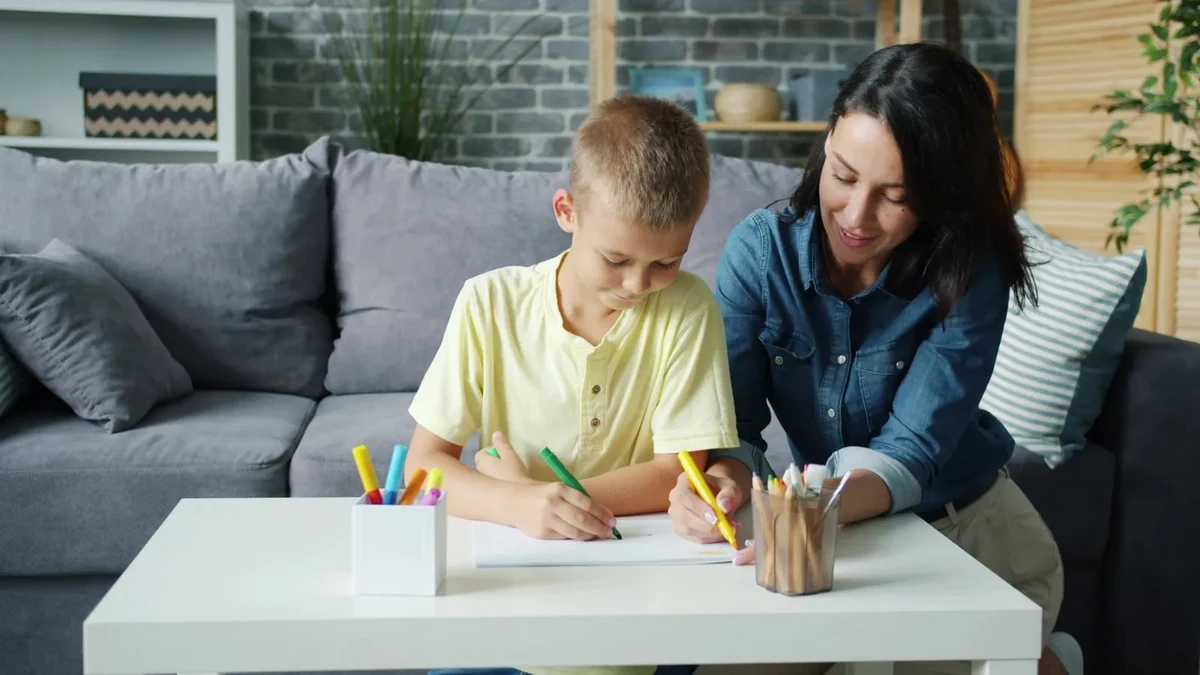
Handwriting Still Matters: Improving Your Child's Writing
Last verified: 9 November 2026 | Reading Time: 8 min | Author: Najma
Your child knows the answer. They can say it out loud, clearly and correctly. But when they write it down, the letters wander off the line, the words crowd together, and even they cannot read what they wrote five minutes later. If that sounds familiar, you are not alone — and it is fixable. Handwriting is not a talent children are born with. It is a physical skill built from four parts: posture, grip, letter formation, and practice. Fix the parts in the right order, and the writing improves — usually faster than parents expect.
It still matters, even in a world of phones and tablets. The entrance exams your child will sit — JNVST, AISSEE, AMU and JMI school entrances — are all pen-and-paper exams. Answers are written by hand, under a time limit. A child who writes slowly, or whose writing the examiner struggles to read, loses marks they actually earned. Neat, fast handwriting is not about looking pretty. It is about letting the child's knowledge reach the paper intact.
The Four Building Blocks of Good Handwriting
Before buying a single workbook, check the four foundations. Occupational therapists who work on children's handwriting describe it the same way: writing is a whole-body skill, not just a finger skill. Posture: both feet flat on the floor, back resting against the chair, and the paper at a slight angle. The rule therapists use is 90/90/90 — hips, knees and ankles each at roughly a right angle. A child writing with dangling feet or a hunched back is fighting their own body before they write a single letter. Grip: the pencil held between thumb, index and middle finger — the dynamic tripod grip — with the ring and little fingers curled into the palm. Letter formation: every letter starts at the top and moves down, in the same stroke order every time. Practice: short, daily, and focused on quality over quantity. If any one of the four is missing, the others cannot compensate for it.
Fix the Grip First — Before the Writing
Most messy handwriting starts with the grip, not the letters. Watch your child write for two minutes and look for these signs: the pencil gripped in a full fist, the thumb wrapped right around the pencil, the pencil held far up the shaft, or the hand turning white from squeezing too hard. A child gripping like this will tire after a few lines, press too hard, and write slowly — and no amount of copy-writing will fix it, because the tool is being held wrong.
The fixes are simple and cheap. First, shorten the pencil: break a crayon in half or sharpen a pencil down to about the length of the child's hand. A short pencil cannot be held in a fist, so the fingers naturally fall into a tripod grip. Second, try the pom-pom trick: give your child a small ball of cotton or a marble to hold in the palm with the ring and little fingers while writing — it keeps those fingers tucked away and frees the writing fingers to move. Third, a triangular pencil or a soft pencil grip from any stationery shop can guide finger placement while the new grip becomes habit. Retrain gently and early: therapists note that an established grip becomes very hard to change after around Class 3, so the earlier you correct it, the easier it is. Do not nag during homework — set aside five minutes of grip practice separately, then let the child write normally.
Teach Letters the Right Way: Top Down, in Families
Children who form letters any way they like end up slow, because every letter becomes a new puzzle. The rule to teach is one sentence: every letter starts at the top. Practise it until it is automatic. Say the movement out loud as the child writes it — "start at the top, go down, back up and round" for the letter a — because hearing the instruction while doing the movement helps it stick.
Teach letters in families, not in alphabetical order. The letters c, a, d, g, o and q all start with the same curve-back movement, so learning them together is easier than learning them scattered across the alphabet. Similarly, l, i, t and h share a straight-down start, and n, m, r and u share a down-and-up pattern. Practise big before small: a new letter first in the air with a big arm movement, then large on a whiteboard or in a tray of sand or semolina, and only then small on lined paper. The sand tray matters more than it sounds — feeling the shape while making it builds the memory of the movement, and children who struggle on paper often get it right in sand first. If your child reverses letters like b and d, that is common up to Class 2 and usually fades with correct formation practice; if it persists strongly past Class 3, mention it to the class teacher.
The 10-Minute Daily Drill That Actually Works
Handwriting improves with short daily practice, not with weekend marathons. Ten to fifteen minutes a day is the amount occupational therapists recommend for primary-school children — long enough to build the habit, short enough that the hand does not tire and the child does not start to hate it. Here is a week that covers all four building blocks without needing any special material:
| Day | Drill (10 minutes) | What it builds |
|---|---|---|
| Monday | Grip check + 2 lines of one letter family (e.g. c, a, d, g) on ruled paper | Grip + formation |
| Tuesday | Sand-tray or air-writing of 3 tricky letters, saying each stroke aloud | Letter memory |
| Wednesday | Copy 4 short sentences, focusing on spaces between words (one finger-width) | Spacing + speed |
| Thursday | Hand-strength play: clay, tearing paper, pegs, or squeezing a sponge | Hand strength |
| Friday | Rewrite yesterday's sentences, a little faster, keeping letters on the line | Fluency |
| Saturday | Free writing: a 5-line diary entry or a letter to a grandparent | Real writing |
| Sunday | Rest — or compare this week's page with last week's and celebrate the difference | Motivation |
Keep one rule above all: quality over quantity. Two neat lines beat two pages of rushed scribble, because rushed scribble practises the wrong movement. If the child finishes the drill early, stop — do not add more lines as a reward for finishing. And keep the drill separate from homework: homework is for learning the subject, drill time is for learning the writing. Mixing the two makes both worse. For fitting this into the day without a battle, our Class 5 study timetable shows where a 10-minute drill fits, and our guide on helping with homework without doing it explains the parent's role during written work.
Three Mistakes Parents Make With Handwriting
1. Correcting every letter as it is written. Constant interruption breaks the child's flow and teaches them that writing is a test, not a skill. Let the child finish the line, then pick one thing to fix — the worst letter, or the spacing — and praise what was right first. 2. Buying a thick workbook and assigning pages. A child handed 20 pages of copy-writing will rush through them to finish, practising the same bad habits faster. Short, watched practice beats long, unwatched practice every time. 3. Comparing with a sibling or classmate. Handwriting develops at very different speeds, and hand strength — the physical base of it — matures on its own schedule. Compare your child only with their own work from last month; that is the comparison that shows real progress and keeps them willing to try. If writing sessions regularly end in tears or the child's hand hurts after a few lines, that is not a discipline problem — it is a sign to pause and look at grip, posture, and hand strength, as described above.
When to Get Extra Help
Most handwriting problems improve with the drills above over a few weeks. But seek an assessment from an occupational therapist if: your child's hand gets tired or hurts after a few lines; the grip stays very awkward or very tight despite weeks of reminders; letters stay reversed or badly formed well past Class 3; or your child avoids writing altogether and gets distressed by it. These can be signs of weak underlying fine-motor skills, or of dysgraphia — a learning difficulty that affects writing — and an assessment finds out exactly what is holding the writing back, so the help targets the real cause. Talk to the class teacher first: they see your child's writing every day and can tell you whether it is behind the class or simply developing on its own timeline. Entrance preparation also rewards legible writing — in our JNVST self-study plan and spaced-repetition revision guide, written recall is the main practice method, so the faster and clearer your child writes, the more they can revise in the same time.
Want your child's written work checked by a coach, not just a workbook?
JGPS runs structured AMU, JMI, Navodaya, and Sainik School coaching batches in Joya, Amroha, where written practice is marked and corrected every week. Call admissions on +91 9997161490 to discuss your child's class and target exam — or visit the school to see a batch in session.